Walt Whitman
About
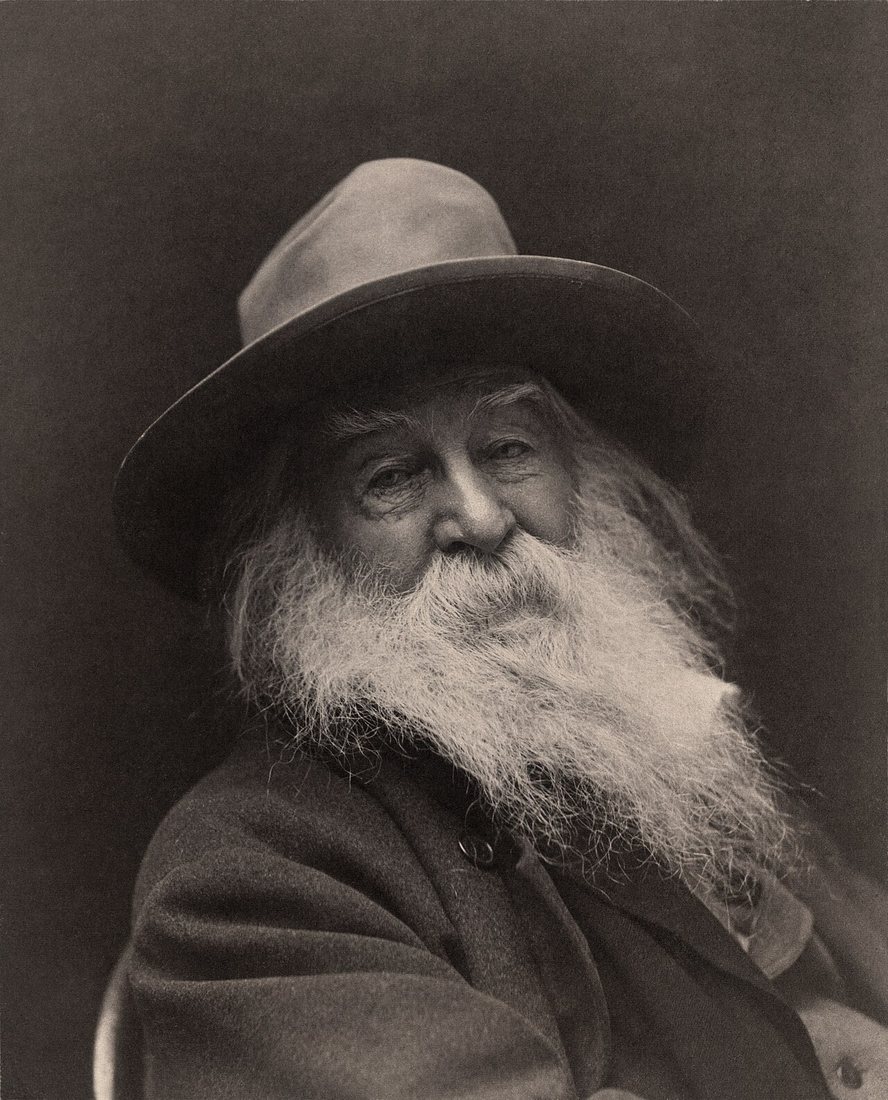
Walt Whitman was born on May 31, 1819, at West Hills, in the town of Huntington on Long Island. He learned the printing trade as a boy, taught in country schools on Long Island from 1836 to 1841, and edited newspapers, the Brooklyn Daily Eagle among them, from March 1846 until January 1848.
In 1855 he published Leaves of Grass at his own cost, printed in Andrew Rome’s shop in Brooklyn. Its title page carried no author’s name; an engraving of the poet in his working clothes faced it. He went on remaking the book for the rest of his life, through new editions and annexes, to the Philadelphia printing of 1891–92.
In December 1862 he went to Virginia to find his brother George, wounded at Fredericksburg, and stayed on in Washington to visit the soldiers in its hospitals. A clerk at the Department of the Interior, he was dismissed in June 1865 by the Secretary, James Harlan, over Leaves of Grass, and within a day had a post in the Attorney General’s office.
A stroke in January 1873 left him paralyzed in part, and that May he came to Camden, New Jersey, where his mother was dying. In 1884 he bought the house at 328 Mickle Street, the first he owned. He died there on March 26, 1892, and lies in Harleigh Cemetery, in a tomb of his own design.
Shorter, for a program or a festival
About 50 wordsWalt Whitman (1819–1892) was a printer, a country schoolteacher and a Brooklyn newspaper editor before he published Leaves of Grass at his own cost in 1855. He remade the book for the rest of his life, nursed the wounded in Washington’s Civil War hospitals, and died in Camden, New Jersey.
About 100 wordsWalt Whitman was born on Long Island in 1819 and worked as a printer, a country schoolteacher and a newspaper editor, the Brooklyn Daily Eagle among his papers. In 1855 he published Leaves of Grass at his own cost, with no name on the title page and his portrait facing it; Ralph Waldo Emerson greeted it as “the beginning of a great career.” During the Civil War he visited the wounded in Washington’s hospitals. He spent his last nineteen years in Camden, New Jersey, remaking Leaves of Grass edition by edition, and died there in 1892.